As a BDC Manager with over two decades in the automotive management and digital transformation trenches, I have seen every “game-changing” technology come and go. From the first primitive CRMs to the explosion of third-party lead providers, the industry is constantly chasing a silver bullet. Today, that silver bullet is Artificial Intelligence. The promise is intoxicating: 24/7 coverage, instant responses, and zero payroll taxes. But as someone who has lived through the evolution of the BDC, I’m here to issue a warning: if you hand your entire customer journey over to a bot, you are trading your long-term brand equity for short-term efficiency.
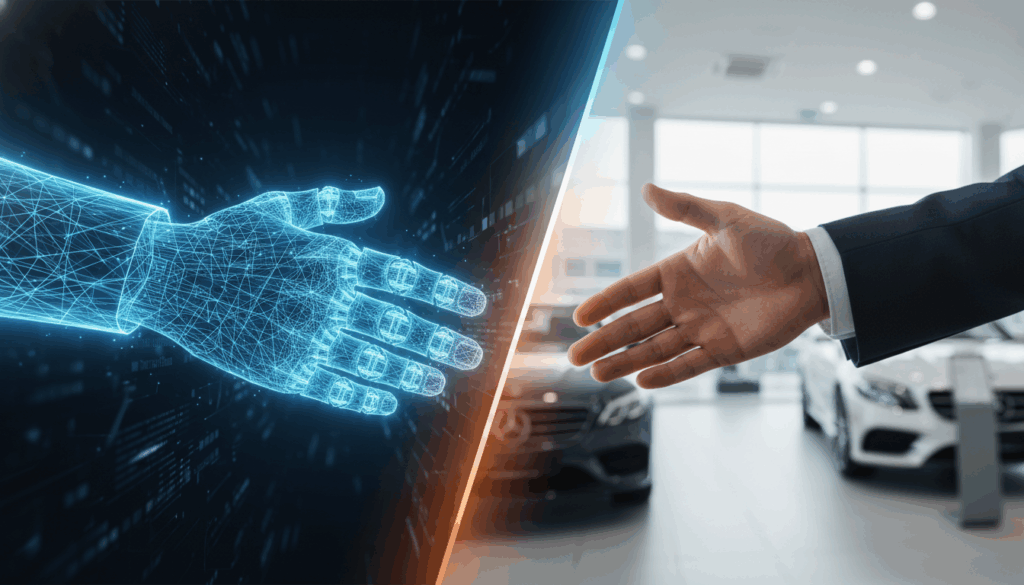
We are entering the era of the “Cyborg” BDC. This isn’t about choosing between humans or machines; it’s about the strategic integration of both. The goal of an AI in automotive BDC strategy should not be to replace your people, but to augment them—creating a hybrid entity that possesses the lightning-fast reflexes of a computer and the high-level emotional intelligence of a seasoned sales professional. When we get this balance right, we see a 15% increase in show rates over dealerships that rely solely on one or the other.
The Trap of Over-Automation
The allure of “set it and forget it” is the siren song of the modern dealership. It is tempting to look at a mounting pile of leads and think, “If I just turn on the AI voice bot or the automated SMS sequence, my problems are solved.” This is a dangerous fallacy. Pure automation creates a “robotic detachment” that savvy modern car buyers can smell from a mile away.
The problem with over-automation is that it operates on logic, whereas car buying is an inherently emotional process. An AI can tell a customer that a Toyota Camry is in stock; it cannot understand the subtle hesitation in a mother’s voice when she asks about rear-seat legroom for a growing family. It cannot sense the frustration of a credit-challenged buyer who has been rejected elsewhere. When you automate the “Ask for the Appointment” on a hot, fresh lead, you are treating a human being like a data point. You might get a “yes” in the chat box, but without a human connection, that “yes” rarely turns into a “show” on the showroom floor.
Furthermore, over-reliance on AI leads to “skill atrophy” in your BDC. If your agents are only ever handling the “scraps” that the AI couldn’t close, they lose the ability to build value, handle objections, and execute the scripts that actually move the needle. You end up with a team of data entry clerks rather than a team of appointment setters. The cautionary tale here is simple: Use AI to clear the path, but never let it drive the car during the moments that matter most.
The Cyborg Workflow Defined
To succeed in today’s market, we must define exactly where the machine ends and the human begins. In a Cyborg BDC, the AI is the “First Responder” and the “Data Miner,” while the human is the “Closing Specialist” and the “Value Builder.”
AI is objectively better at speed. In a world where lead response time is measured in seconds, not minutes, a human agent cannot compete. The AI should handle the immediate lead acknowledgment, confirming that the message was received and providing basic vehicle availability. It should also be used to revive “dead” leads—those 90-day+ prospects sitting in your CRM that your team doesn’t have the bandwidth to call. AI can sift through thousands of these dormant files to surface the 2% who are suddenly back in the market.
However, the moment a lead shows “high-intent” behavior—asking about a specific trade-in value, inquiring about a particular feature, or expressing a price concern—the “Cyborg” must hand the reigns to a human. This is where the appointment is truly won or lost. The human agent uses the data surfaced by the AI (such as sentiment analysis or browsing history) to go into the call prepared with a strategy.
| Task | AI Agent | Human BDC Agent |
|---|---|---|
| Initial Response Time | < 1 Minute | 5-15 Minutes |
| Sentiment Analysis | High Accuracy | Varies by Mood |
| Objection Handling | Logic-Based | Emotion/Empathy-Based |
| Appointment Confirmation | Automated SMS | Voice Verification |
As the table illustrates, the AI provides the foundation of efficiency, but the human provides the nuance of execution. A logic-based bot will try to overcome a price objection by offering a discount or a payment calculator. A human agent, trained in the “Cyborg” mindset, will use empathy to discover the reason behind the price concern and build enough value in the vehicle and the dealership to make the price secondary. For a deeper look at why technology alone fails, read our analysis on why AI Alone Won’t Fix Your BDC.
Where Alan Ram’s Scripts Fit in an AI World
The biggest mistake BDC Managers make when implementing AI is thinking they no longer need to train their people on phone scripts. In reality, the “Cyborg” model makes high-level phone training more important, not less. Because the AI is filtering out the “noise” and the “tire kickers,” the leads that do reach your human agents are higher quality and higher stakes. You cannot afford to blow these opportunities with a generic “When can you come in?” approach.
This is where the Alan Ram philosophy of “Value Building” becomes the ultimate weapon. An AI can confirm an appointment, but it cannot execute the “Why Buy Here” script with conviction. It cannot effectively “Control the Call” when a customer tries to hijack the conversation by demanding a bottom-line price before they’ve even seen the car.
In a Cyborg BDC, the human agent uses the AI-provided data to personalize the Alan Ram scripts. For example, if the AI’s sentiment analysis indicates the customer is frustrated with their current vehicle’s reliability, the human agent doesn’t just ask for an appointment. They pivot: “I understand you’re looking for something more dependable. Beyond just the car, the reason people come to us is our 10-year powertrain warranty and our certified technicians who ensure you aren’t back in a service bay a month from now. I have an opening at 2:15 or 4:45 to show you exactly how we stand behind our vehicles—which works better for you?”
The “human edge” is the ability to listen for what isn’t being said. AI analyzes keywords; humans analyze intentions. By using AI to handle the mundane tasks, we free up our agents’ mental bandwidth to focus entirely on the psychology of the sale. This hybrid approach ensures that we are not just “processing” leads, but actively converting them into showroom traffic.
Implementation Checklist
Ready to transition to a Cyborg BDC? Use this checklist to ensure you are integrating AI without losing your soul:
- Audit Your Current Tech Stack: Identify where your AI is currently interacting with customers. Is it handling fresh leads or just service reminders?
- Define the “Human Hand-Off”: Establish clear triggers for when an AI conversation must be transferred to a live agent. High-intent keywords like “best price,” “trade value,” or “disappointed” should trigger an immediate human alert.
- Refresh Your Phone Training: Don’t let your team’s skills get rusty. Double down on “Why Buy Here” and objection-handling scripts. Remember: The bot handles the “What,” the human handles the “Why.”
- Automate the “Dead” Leads Only: Use AI to scrub your database for 90-day+ leads. Do not allow AI to be the primary voice for your fresh, high-dollar inbound traffic.
- Monitor Sentiment, Not Just Volume: Use AI’s reporting tools to see how customers are talking to your bots. If the sentiment is trending negative, your automation is too aggressive.
- Voice Verification for Appointments: While AI can send a reminder text, a human should still make the “confirmation call” for high-value sales appointments to build rapport and decrease no-show rates.
The future of the automotive industry isn’t a world of robots selling cars to humans. It’s a world where the most successful dealerships use technology to be more human, not less. By adopting a Cyborg BDC strategy, you leverage the speed of AI to win the race to the lead, and the wisdom of human training to win the heart of the customer.
Frequently Asked Questions
Q: Will AI replace car dealership BDCs?
A: No. AI is excellent at data entry, initial speed-to-lead, and basic follow-up. However, it cannot replicate the emotional intelligence, empathy, and complex value-building required to overcome price objections and secure appointments with skeptical buyers. The BDC of the future is a hybrid model.
Q: How does AI help with show rates?
A: By handling the “busy work,” AI allows human agents to focus their time on high-quality confirmation calls and personalized video follow-ups. Dealerships using a hybrid AI/Human model typically see a 15% increase in show rates because the human interaction is more focused and valuable.
Q: What is the biggest mistake when using AI in a BDC?
A: Treating AI as a replacement for training. When BDC agents think the AI will “do the work” for them, their phone skills decline, leading to a massive drop in conversion when they actually do get a live prospect on the line.
Train your humans to beat the bots. Learn more about our human-centric training solutions here.