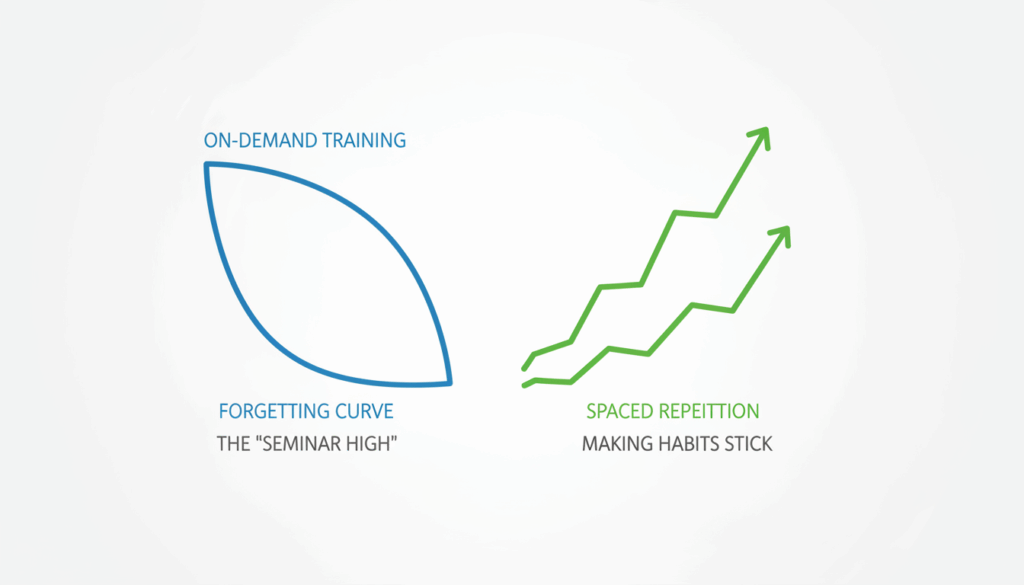
As a Dealer Principal, I have sat through my fair share of high-octane sales seminars. I’ve seen the charismatic trainers, the flashy PowerPoint decks, and the “rah-rah” energy that fills the room. For eight hours, the sales floor feels unstoppable. My team is fired up, they are taking notes, and they are making bold promises about how many units they are going to move this month. We call this the “Seminar High.”
But then, Monday morning arrives. By Wednesday, the notebooks are buried under a pile of lead sheets. By Friday, the “new techniques” have been replaced by the same old comfortable habits. Within a week, the $10,000 investment in that live trainer has evaporated, leaving behind nothing but a few lingering buzzwords. This isn’t just a frustration; it’s a systemic failure in how we approach professional development in the automotive industry.
The reality is that motivation is perishable, while habits are durable. To truly move the needle on your closing ratios and PVR (Per Vehicle Retail), we have to stop treating training like a one-time event and start treating it like a daily discipline. This is where the automotive sales training LMS benefits become undeniable. By shifting from the “fire hose” method to a consistent, on-demand model like AdaptVT, we can finally bridge the gap between knowing what to do and actually doing it on the showroom floor.
The Biology of Forgetting
Why do even the most talented salespeople struggle to retain information from a live seminar? The answer isn’t a lack of effort; it’s basic human biology. In the late 19th century, psychologist Hermann Ebbinghaus pioneered the study of memory, leading to the discovery of the “Forgetting Curve.” His research yielded a sobering truth: without reinforcement, the human brain is designed to discard information it doesn’t use immediately.
The data shows that 75% of information is lost within just six days if there is no deliberate attempt to retain it. When you fly a trainer in for an 8-hour session, you are effectively trying to drink from a fire hose. The brain’s working memory can only handle so much at once. Once it reaches capacity, the excess information is simply “deleted” to make room for the next task—like greeting a customer or responding to an email.
In a dealership environment, the Forgetting Curve is even more aggressive. The high-stress, fast-paced nature of the floor triggers the release of cortisol, which can further inhibit the formation of long-term memories. For a sales skill to stick, it must move from the prefrontal cortex (where we process new, conscious information) to the basal ganglia (the part of the brain responsible for habits and procedural memory). This transition cannot happen during a one-off seminar. It requires repetition over time—a process known as “synaptic plasticity.”
The ‘Seminar High’ Explained
The “Seminar High” is a psychological phenomenon driven by dopamine and social contagion. When a team gathers for a live event, the collective energy creates a temporary spike in motivation. The trainer tells inspiring stories, the team laughs together, and for a moment, the challenges of the job seem easily surmountable. However, this is an emotional state, not a skill-based state.
The problem with relying on seminars is that they rely on willpower. We expect our sales team to return to the floor and use their sheer force of will to implement new scripts and objection-handling techniques. But willpower is a finite resource. As soon as a salesperson deals with a difficult “up” or a grind-out negotiation, their willpower drains, and they revert to their “path of least resistance”—their old, unoptimized habits.
Furthermore, seminars lack individual accountability. Once the trainer leaves, who is ensuring the techniques are being practiced? As a Dealer Principal, you can’t be everywhere at once. Without a system to track progress and reinforce the curriculum, the “Seminar High” becomes a very expensive form of entertainment rather than an investment in human capital.
| Feature | Live Seminar | AdaptVT (LMS) |
|---|---|---|
| Engagement | High (Short Term) | Consistent (Long Term) |
| Cost | High (Travel/Tickets) | Low (Subscription) |
| Retention | < 10% after 30 days | > 80% with daily use |
| Accountability | Zero | Full Dashboard Tracking |
Spaced Repetition: The AdaptVT Model
If the “fire hose” approach fails because of the Forgetting Curve, what is the solution? The answer lies in Spaced Repetition. This is the practice of learning small “nuggets” of information and revisiting them at increasing intervals. This is the core philosophy behind the AdaptVT model.
Instead of an 8-hour marathon once a quarter, on-demand training allows for 10-minute daily drills. This is “micro-learning,” and it is the most effective way to build professional-grade habits. One of the primary automotive sales training LMS benefits is the ability to integrate training into the natural downtime of a dealership. Between appointments or during a quiet morning, a salesperson can engage with a simulation-based module that reinforces a specific skill—like the transition from the walk-around to the write-up.
AdaptVT’s USP (Unique Selling Proposition) is its simulation-based learning model. Most LMS platforms are just “video graveyards” where salespeople hit play and zone out. AdaptVT requires active participation. It simulates real-world customer interactions, forcing the learner to make choices and handle objections in a safe, digital environment. This “active recall” is what strengthens neural pathways. It’s the difference between watching a video of someone swinging a golf club and actually hitting 500 balls at the range with a pro correcting your grip.
When training is on-demand and interactive, it becomes a part of the dealership’s culture. It isn’t something they “went to”; it’s something they “do.” To understand more about the mechanics of why this works, you can read The Truth About Training That Works.
How to Structure Daily Training
Transitioning from the “Seminar High” to a habit-based LMS model requires a shift in leadership strategy. As the Dealer Principal or General Manager, your role is to set the expectation that training is as vital as checking the inventory or managing the CRM. Here is how to structure that daily discipline:
- The 10-Minute Rule: Mandate that every salesperson completes one 10-minute module on AdaptVT before the morning sales meeting. This primes their brain for the day ahead.
- Morning Meeting Reinforcement: Use the morning meeting to discuss the specific skill covered in that day’s LMS module. If the module was on “Handling the Trade-In Objection,” have two salespeople role-play that specific scenario for three minutes.
- Data-Driven Coaching: Use the LMS dashboard to identify gaps. If the data shows a salesperson is struggling with the “Closing” modules but acing the “Lead Response” modules, you can provide surgical coaching rather than a generic lecture.
- The “Save-a-Deal” Integration: When a deal goes sideways, have the salesperson go back to the LMS and find the specific module that addresses where the breakdown occurred. This turns a lost sale into a concrete learning opportunity.
By implementing this structure, you create a culture of continuous improvement. You are no longer waiting for a quarterly “shot in the arm” from an outside trainer. You are building a self-sustaining engine of skill development. The results are measurable: higher retention of talent, more consistent sales processes, and ultimately, a healthier bottom line.
Frequently Asked Questions
Q: Why is on-demand training better for car dealerships?
A: It allows for consistent, trackable daily training that fits into the downtime of a showroom floor, ensuring skills are practiced year-round. Unlike seminars, it overcomes the Forgetting Curve by using spaced repetition and active simulations to turn knowledge into permanent habits.
Q: My team says they don’t have time for daily training. How do I handle this?
A: The average salesperson has significant downtime between “ups” and during phone follow-ups. By replacing just 10 minutes of social media scrolling with one AdaptVT module, they can significantly increase their closing ratio, which actually saves them time by making their active hours more productive.
Q: Can an LMS really replace a live trainer?
A: While live coaching has its place for high-level strategy, an LMS is superior for fundamental skill building and habit formation. A live trainer can inspire, but an LMS like AdaptVT ensures the execution of those inspirations happens every single day.
The choice is clear. You can continue to chase the fleeting high of the expensive seminar, or you can invest in a system that builds lasting habits and measurable ROI. Stop wasting money on temporary hype and start building a team of professional closers who are sharpened daily.