If you are measuring your BDC’s success by the sheer volume of dials made today, you aren’t managing; you’re observing. In the high-stakes world of automotive retail, activity is often confused with productivity. I have seen BDC departments where agents are making 120 calls a day, yet the showroom floor is a ghost town. This is the hallmark of a department operating without a compass.
As a BDC Manager, your job isn’t to be a cheerleader; it’s to be a data scientist and a performance coach. You need to identify which automotive BDC key performance indicators actually correlate with a sold unit and which ones are simply “vanity metrics” used to mask inefficiency. A daily audit is the only way to ensure your team isn’t just busy, but profitable. This isn’t about micro-management; it’s about high-standard accountability.
The ‘Busy Fool’ Syndrome
The “Busy Fool” syndrome occurs when a BDC department focuses on the wrong end of the funnel. It is easy to report 500 outbound calls to a General Manager who doesn’t know better. It sounds like hard work. However, if those 500 calls resulted in only five conversations and zero appointments, the dealership just paid for eight hours of glorified finger exercises.
We must pivot from quantity to quality. The “Busy Fool” counts dials. The “Profit Architect” counts connections and the conversion of those connections into showroom floor traffic. When you stop obsessing over the “how many” and start auditing the “how well,” you begin to see the cracks in your process. Usually, those cracks are found in the transition from a lead to a conversation, or a conversation to a firm appointment. If your team is “busy” but the board is empty, you are suffering from a lack of direction in your automotive BDC key performance indicators.
The 5 Pillars of Measurement
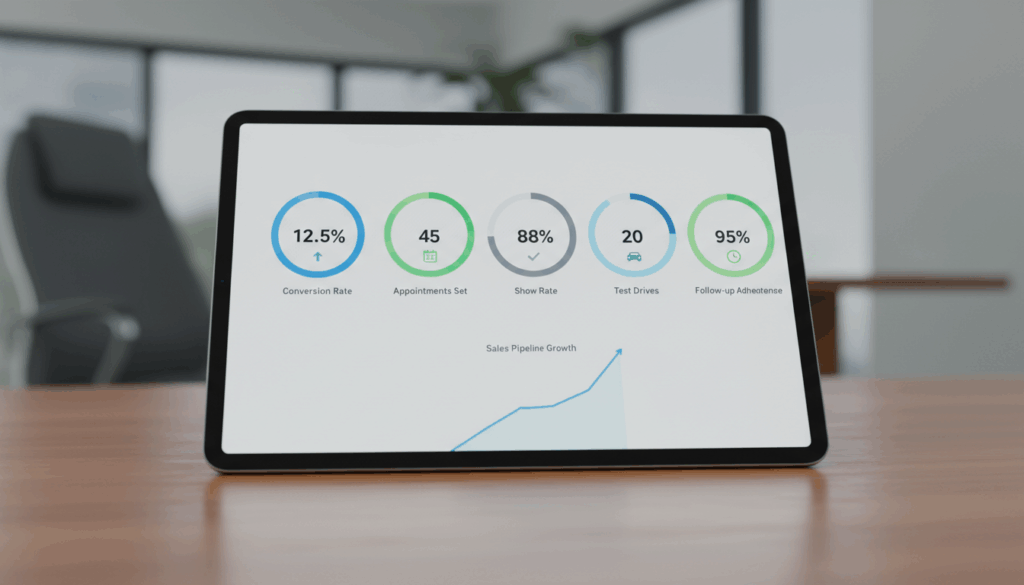
To move beyond the noise, you must focus on five specific pillars. These metrics are the heartbeat of a high-performing BDC. If one of these is out of alignment, the entire sales machine begins to grind to a halt.
1. Connection Rate (Target: 15%+)
Dials are a vanity metric; connections are a sanity metric. The Connection Rate is the percentage of outbound attempts that result in a live conversation with a human being. In the modern era of “Scam Likely” filters and declining pick-up rates, an elite BDC must be strategic. If your connection rate is sitting at the industry average of 8-10%, your team is wasting 90% of their day. Moving this to 15-18% requires a blend of multi-channel outreach (text, email, and video) and strategic timing.
2. Appointment Set Rate (Target: 35% of Contacts)
Once you have a prospect on the line, what happens next? This metric measures the effectiveness of your scripts and the skill level of your agents. If your team is connecting with 100 people but only setting 15 appointments, you don’t have a lead problem; you have a script problem. You should be aiming for a 35% set rate on all live contacts. For more information on how to bridge this gap, see our deep dive on BDC KPIs That Matter.
3. Show Rate (Target: 50%+)
The show rate is the ultimate indicator of the “quality” of the appointment. A low show rate (below 50%) typically indicates that the BDC agent “bullied” the customer into saying yes just to get them off the phone or to hit a daily goal. It also indicates a failure in the confirmation process. High-standard managers ensure that every appointment is backed by a “Why” and followed by a management confirmation call or video.
4. CRM Task Completion
CRM hygiene is non-negotiable. This isn’t a performance metric in the traditional sense, but it is the foundation of all others. If tasks are “red” in the CRM, leads are dying. A daily audit must include a “Zero Red” policy. This ensures that no prospect is forgotten and that the follow-up cadence is being executed with military precision. If a manager isn’t checking task completion daily, they aren’t managing the process; they are hoping for luck.
5. Call Quality Score
Internal data shows that managers who audit calls daily see a 22% lift in appointment quality. You cannot manage what you do not hear. A Call Quality Score is a subjective but essential metric based on a standardized rubric: Did they use a professional greeting? Did they ask for the appointment twice? Did they handle the price objection? Did they set a firm time? Quantifying the quality of the conversation allows you to coach specifically rather than generally.
To understand where your store stands compared to the rest of the market, review the following benchmarks:
| Metric | Industry Average | Elite (Proactive) Standard |
|---|---|---|
| Connection Rate | 8-10% | 15-18% |
| Appt Set Rate | 25% | 40% |
| Show Rate | 40% | 55-60% |
| Sold Rate (of Shows) | 20% | 25%+ |
How to Audit a Call (Checklist)
The daily audit is your most powerful tool for improvement. You should be listening to at least 5-10 calls per agent, per day. When you listen, don’t just listen for the “vibe.” Use a clinical checklist to identify exactly where the conversation succeeded or failed. Use this framework:
- The Greeting: Did the agent identify themselves and the dealership clearly? Was the tone high-energy and professional?
- Discovery: Did the agent ask open-ended questions to identify the customer’s needs, or were they merely an order-taker?
- The Pivot: Did the agent transition from answering a question (price, availability) into asking for the appointment?
- The “Firm” Appointment: Was the appointment set for a specific time (e.g., 2:15 PM) rather than a vague “sometime Tuesday”?
- The Value Proposition: Did the agent give the customer a reason to show up (e.g., vehicle pulled up, manager notified, trade appraisal ready)?
- The Confirmation: Did the agent confirm the customer’s contact info and explain the next steps?
If you find that an agent is skipping the value proposition, you have found exactly why your show rate is low. This turns a “vague feeling” into an actionable coaching moment.
Corrective Training Actions
Data without action is just trivia. Once your daily audit reveals a weakness in your automotive BDC key performance indicators, you must apply the correct “medicine.”
If Set Rates Are Low…
This is a script and confidence issue. Your agents are likely letting the customer lead the call. Corrective action involves role-playing objection handling. Specifically, focus on the “Price Objection” and the “Just Looking” stall. Agents must be trained to answer the question, provide a piece of value, and immediately pivot back to the appointment request.
If Show Rates Are Low…
This is a management and confirmation issue. If a customer doesn’t show, they didn’t see the value in the visit. To fix this, implement a “Manager Confirmation Call” protocol. Within 15 minutes of an appointment being set, a BDC Manager or Desk Manager should call to thank the customer and confirm the details. This adds a layer of “social obligation” that dramatically increases show rates. Additionally, ensure agents are sending a “Video “Walk-around” of the specific vehicle the customer is interested in—this creates a personal connection that a phone call cannot match.
If Connection Rates Are Low…
This is a strategy issue. You may be calling at the wrong times or using the wrong “Caller ID” strategy. Audit your lead sources—are some sources providing bad data? If so, shift your focus. Also, ensure your team is using “The Rule of 3”: a call, a text, and an email within the first 10 minutes of lead arrival. Persistence is the only cure for a low connection rate.
Effective BDC management requires a relentless pursuit of the “Elite Standard.” By focusing on the metrics that actually predict sales—Connection, Set, and Show rates—you move your team from a cost center to a profit center. Stop counting the dials and start auditing the results.
Frequently Asked Questions
Q: What is a good show rate for a car dealership BDC?
A: A healthy BDC should maintain a show rate between 50% and 60%. Anything below 50% indicates a failure in the confirmation process or a lack of value established during the initial call.
Q: How many calls should a BDC agent make a day?
A: While dials shouldn’t be the only focus, a standard benchmark is 80-100 attempts per day. However, if an agent has a high connection and set rate, a lower dial count is acceptable because they are spending more time on the phone with live prospects.
Get the tools to measure what matters. Visit our ROI and Performance Calculator here: https://proactivetrainingsolutions.com/calculator/