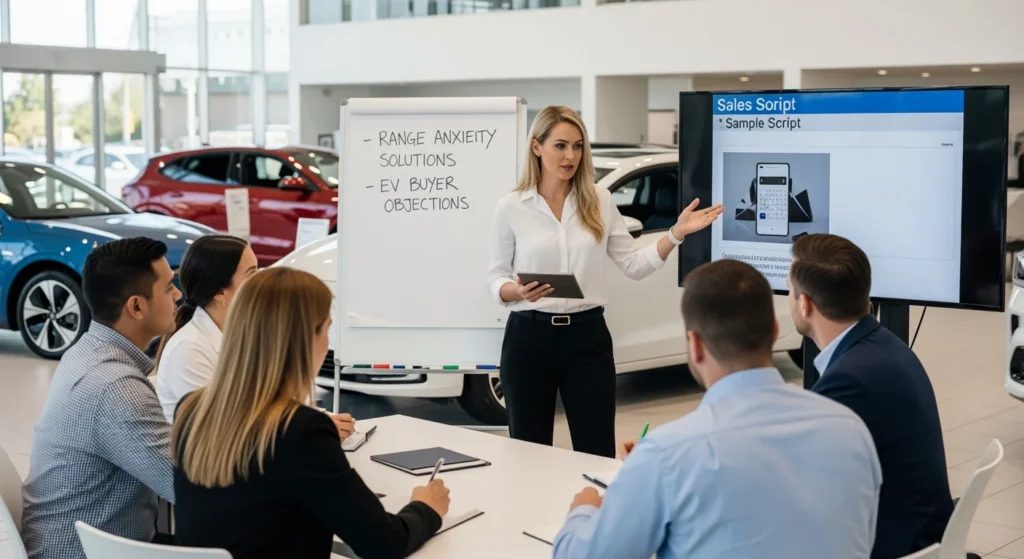
Key Takeaways for January 2026
- The Conversation Has Shifted: In 2026, “Range Anxiety” is often actually “Charging Anxiety.” Your team must know the difference.
- Consultant vs. Clerk: You cannot sell an EV using a spec sheet. You must use a “Lifestyle Consultation” approach to validate the customer’s daily needs.
- The “95% Rule”: Phone scripts should focus on the 95% of driving that is local, rather than the 5% that is long-distance.
- Data-Backed Confidence: The average 2026 EV offers 300+ miles of range; use this stat to confidently overcome objections early in the call.
It is January 2026. The average electric vehicle (EV) on your lot now boasts a range of over 300 miles. Public charging infrastructure has improved dramatically under the NEVI program. Yet, when the phone rings, the hesitation in the customer’s voice is the same as it was five years ago: “But what if I run out of power in the middle of nowhere?”
Your sales team might be tired of hearing it, but to the customer, the fear is real. If your BDC or sales professionals dismiss this fear with a simple “Oh, don’t worry, it has plenty of range,” you have likely already lost the appointment.
To win in this market, you need specific, high-level training that addresses the psychology of the 2026 buyer.
Selling electric vehicles dealership training is a specialized curriculum designed to transform sales consultants into “Lifestyle Navigators.” It moves beyond basic product knowledge (specs and trim levels) to focus on objection handling, empathy, and the logical reframing of a customer’s driving habits to demonstrate how an EV improves, rather than hinders, their daily life.
The 2026 EV Landscape: Why “What If” Still Rules
Despite the average EV range hitting 300+ miles and premium models exceeding 400 miles, the psychological barrier remains. Why? Because we are now selling to the “Early Majority” and “Late Majority.” These aren’t the tech enthusiasts of 2020 who forgave minor inconveniences. These are practical buyers who value reliability above all else.
In 2026, the objection has subtly shifted. It is less about “Can the car make it?” and more about “Will I find a working charger when I get there?” This is defined as Charging Anxiety vs. Range Anxiety.
Your team must be equipped to handle this distinction instantly on the phone. If they can’t, you need to Keep Pace with Rapid Product Changes and update your training immediately.
Essential Phone Scripts for Overcoming Range Anxiety
The goal of the phone call is never to sell the car—it is to Master the Modern Sales Call and sell the appointment. However, you cannot get the appointment if you don’t neutralize the anxiety first.
Here are three essential scripts (“Word Tracks”) for 2026:
1. The “Daily Drive” Reframe
Customer: “I like the look of the new SUV, but I’m worried about the range. 300 miles doesn’t sound like enough for road trips.”
Salesperson: “I completely understand that concern, John. Nobody wants to be stranded. Let me ask you—how many miles do you typically drive on an average Tuesday?”
Customer: “Maybe 30 or 40 miles.”
Salesperson: “Great. So, for 360 days out of the year, this vehicle has about 8 times the range you actually need. For those few road trips, the navigation system in this 2026 model actually reserves chargers for you in advance. When can you come in to see how that predictive mapping works? I have an opening at 2:15 or would 4:45 be better?”
Why it works: It uses logic to isolate the objection to a rare event (road trips) and then pivots immediately to an appointment closing question.
2. The “Infrastructure Assurance” Technique
Customer: “I hear the charging stations are always broken or full.”
Salesperson: “That was definitely a headline a few years ago, Sarah. But are you aware of how the 2026 networks have changed? Most of our clients now treat their car like their smartphone—they charge it at home while they sleep and wake up with a ‘full tank’ every morning. Do you have access to a driveway or garage where you park at night?”
Customer: “Yes, I have a garage.”
Salesperson: “Perfect. Then for you, the public charging station issue essentially disappears. You fuel up at home. I’d love to show you how simple the home setup is. Are you available this evening, or would tomorrow morning work better?”
Why it works: It validates the customer’s knowledge but updates it with current reality, leveraging the “smartphone” analogy which is universally understood.
3. The “Road Trip” Reality Check
Customer: “We drive to see family in the next state, it’s about a 400-mile drive. This car won’t make it.”
Salesperson: “That’s a great drive. On a 400-mile trip, do you typically drive straight through for 6 hours without stopping for food or a restroom break?”
Customer: “No, we usually stop for lunch.”
Salesperson: “Exactly. With the DC fast charging on this model, a 20-minute lunch stop adds about 200 miles of range. So you’re refueling your body and the car at the same time, without losing any time. I have the demo charged up and ready. When can you stop by to take it for a spin?”
Data Table: The “Refueling” Paradigm Shift
Sometimes, customers need to see the data to believe it. Use this comparison when training your team to explain the time savings of an EV, rather than just the range.
| Feature | Internal Combustion Engine (ICE) | Electric Vehicle (EV) 2026 |
|---|---|---|
| Primary Refueling Location | Gas Station (Detour required) | Home/Work (Destination based) |
| Frequency of Stops | 1-2 times per week | Plug in daily (takes 10 seconds) |
| “Refueling” Time Cost | ~10-15 mins/week standing at pump | ~0 mins/week (happens while sleeping) |
| Range on Full Tank/Charge | 350-450 miles | 300-450 miles (2026 Avg) |
| Cost Per Mile (Avg) | $0.15 – $0.20 | $0.04 – $0.06 |
This table illustrates that while an EV might require longer stops on road trips, it saves the customer time during the entire rest of the year.
Training Your Team: Beyond the Spec Sheet
Your sales team cannot wing this. If they hesitate when asked about range, the customer’s anxiety is validated. Confidence is contagious.
To truly succeed, you must From Inbound Call to Sold Unit, standardize your EV training process. This includes:
- Role-Playing Objections: Don’t just read the scripts. Practice them until the tone is natural. Why Tone Matters cannot be overstated—if your salesperson sounds defensive about the range, the customer will notice.
- Understanding the Grid: Ensure your team knows the basics of Level 2 vs. Level 3 charging. Check the Department of Energy for the latest terminology.
- Internet Lead Handling: Many EV inquiries come in via the web. Ensure your Internet Lead Handling processes are specifically tuned for EV questions, avoiding generic auto-responses that ignore their specific concerns.
FAQ: Handling EV Objections
What if the customer doesn’t have a garage?
Pivot to workplace charging or local public infrastructure. In 2026, many apartment complexes and workplaces have installed Level 2 chargers. Ask: “Do you have charging available at your office? Many of our clients actually charge for free while they work.”
Is range anxiety still a deal-breaker in 2026?
It is less of a technical deal-breaker and more of an emotional one. According to S&P Global Mobility, retention rates for EV owners remain high, meaning once people switch, they rarely go back. The anxiety is purely fear of the unknown.
How do I train my veteran salespeople on this?
Veterans often struggle the most because they are used to selling horsepower and torque. Frame EV sales as a “consultative sale” rather than a “commodity sale.” Remind them that solving the “lifestyle puzzle” builds higher trust and gross profit.