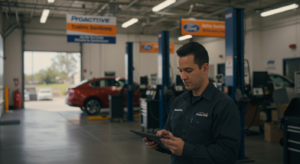
Ask any dealership if they train their team, and the answer is always yes. But ask what that training actually looks like, and you’ll hear about a one-day session last quarter, a vendor walkthrough, or a few videos saved on someone’s desktop. That’s not training. That’s exposure. And exposure doesn’t change behavior.
The gap between what dealerships call “training” and what actually produces lasting skill improvement is enormous. According to the Training Industry research on the forgetting curve, learners forget up to 90% of new information within one week without structured reinforcement. For dealerships investing in training that doesn’t stick, the cost isn’t just the program fee — it’s the lost revenue from teams that never actually improve.
1. Training Isn’t Something You Did — It’s Something You Do
One-time training events don’t build skill. Sales consultants forget. Managers drift. Bad habits return. The fundamental mistake most dealerships make is treating training as a past-tense event rather than a present-tense system.
Effective training has four essential characteristics. It must be repetitive because learning fades without reinforcement. It must be interactive because passive information doesn’t stick. It must be observed because practice without feedback produces no improvement. And it must be tied to goals because behavior needs direction to produce results.
If your “training” isn’t addressing all four characteristics, it’s a pep talk — not a system. The distinction matters because pep talks create temporary enthusiasm, while systems create permanent capability. Research from the Association for Talent Development (ATD) confirms that organizations with comprehensive training programs generate 218% higher income per employee than those without formalized programs.
2. The 3-Phase Formula: Teach, Practice, Coach
Training that actually changes outcomes follows a specific rhythm. At Proactive Training Solutions, we call it the teach-practice-coach loop, and every effective dealership training program uses some version of this framework:
Phase 1: Teach. Introduce the concept clearly using real-world dealership context. Keep it simple and immediately applicable. A sales consultant should be able to use what they learned the same day they learn it. Avoid abstract theory — focus on specific language, specific scenarios, and specific outcomes.
Phase 2: Practice. Roleplay. Simulate. Repeat. Normalize the discomfort of trying new approaches and build fluency through repetition. This is where most dealership training programs fail — they teach but never create structured practice opportunities. Practice must be frequent, brief, and low-stakes to build genuine confidence.
Phase 3: Coach. Observe the salesperson in live customer interactions. Debrief what worked, what didn’t, and what to adjust. This is the phase that transforms knowledge into skill — because without live coaching, there’s no feedback loop connecting training to actual performance on the floor.
Without all three phases, the training loop stays open and results stay flat. Most dealerships execute Phase 1 occasionally, skip Phase 2 entirely, and only do Phase 3 when something goes wrong. The 3-phase formula requires all three running continuously.
3. Why Most Training Fails: The Exposure Trap
The exposure trap is what happens when dealerships confuse information delivery with skill development. Sending the team to a conference, playing a training video in a meeting, or distributing a PDF of best practices all feel like training — but none of them produce behavioral change.
Behavioral change requires friction — the uncomfortable process of doing something new, getting feedback, adjusting, and doing it again. Exposure avoids friction entirely. That’s why it feels productive but produces no measurable improvement in close rates, gross retention, or customer satisfaction scores.
The Gallup State of the American Workplace report found that only 12% of employees strongly agree their organization does a great job of onboarding. The dealership industry performs even worse, with most sales training forgotten within 72 hours of delivery.
4. What Effective Training Looks Like Operationally
In a dealership with effective training systems, you’ll see consistent operational patterns. Daily 15-minute skills huddles before the floor opens, where one specific scenario is practiced. Weekly one-on-one coaching sessions between managers and each salesperson, reviewing specific customer interactions. Bi-weekly roleplay sessions where the team practices objection handling, value building, and phone skills in a structured format. And monthly skill assessments that measure actual behavioral improvement, not just attendance.
This level of structure requires confident, well-trained managers who understand how to coach rather than lecture. Without management development as the foundation, even the best training curriculum fails at the implementation level.
5. Measuring Training ROI at Your Dealership
Effective training produces measurable outcomes. Track these indicators to determine whether your training system is working: close rate improvement by individual and by team, gross per unit trends over 90-day windows, customer satisfaction scores, employee retention rates, and time-to-productivity for new hires.
If your training investment isn’t moving these numbers within 90 days, the program needs restructuring — not more content. The NADA Dealership Financial Profile benchmarks provide baseline metrics to compare against, making it straightforward to quantify whether training is producing returns or just consuming budget.
Ready to replace exposure-based training with a system that builds lasting skill? Learn how to maintain performance consistency with structured coaching rhythms from Proactive Training Solutions.
Frequently Asked Questions
What is the teach-practice-coach methodology?
Teach-practice-coach is a three-phase training loop used in dealership sales development. Phase 1 introduces concepts using real-world scenarios. Phase 2 builds skill through roleplay and simulation. Phase 3 reinforces learning through live observation and feedback during actual customer interactions.
Why does most dealership sales training fail?
Most training fails because it relies on exposure — one-time events, videos, or conferences — rather than structured skill development. Without repetition, practice, and live coaching, salespeople forget up to 90% of training content within one week, producing zero behavioral change.
How often should dealership sales training occur?
Effective training happens daily through brief skills huddles, weekly through one-on-one coaching, bi-weekly through structured roleplay sessions, and monthly through formal skill assessments. This continuous rhythm prevents the forgetting curve from erasing training investment.
What metrics indicate dealership training is working?
Track close rate improvement, gross per unit trends over 90-day periods, customer satisfaction scores, employee retention rates, and new hire time-to-productivity. If these metrics aren’t improving within 90 days of implementing a training program, the approach needs restructuring.
How much does ineffective sales training cost a dealership?
The cost includes the direct program expense plus the opportunity cost of unchanged performance. With average dealership sales turnover exceeding 40% annually and the cost to replace a salesperson estimated at $10,000-$15,000, ineffective training that fails to improve retention alone costs dealerships hundreds of thousands annually.
What role do managers play in making training effective?
Managers are the critical implementation layer. Even the best training curriculum fails without managers who know how to coach, observe, debrief, and hold accountability. Manager development must precede or accompany any sales training initiative for the program to produce lasting results.